Shopping for an engagement ring can feel exciting… and a little overwhelming. There are so many opinions out there about how much you’re “supposed” to spend, what size diamond is best, and whether you need to sacrifice style to stay on budget. The good news? That really isn’t the case anymore.
.jpg)
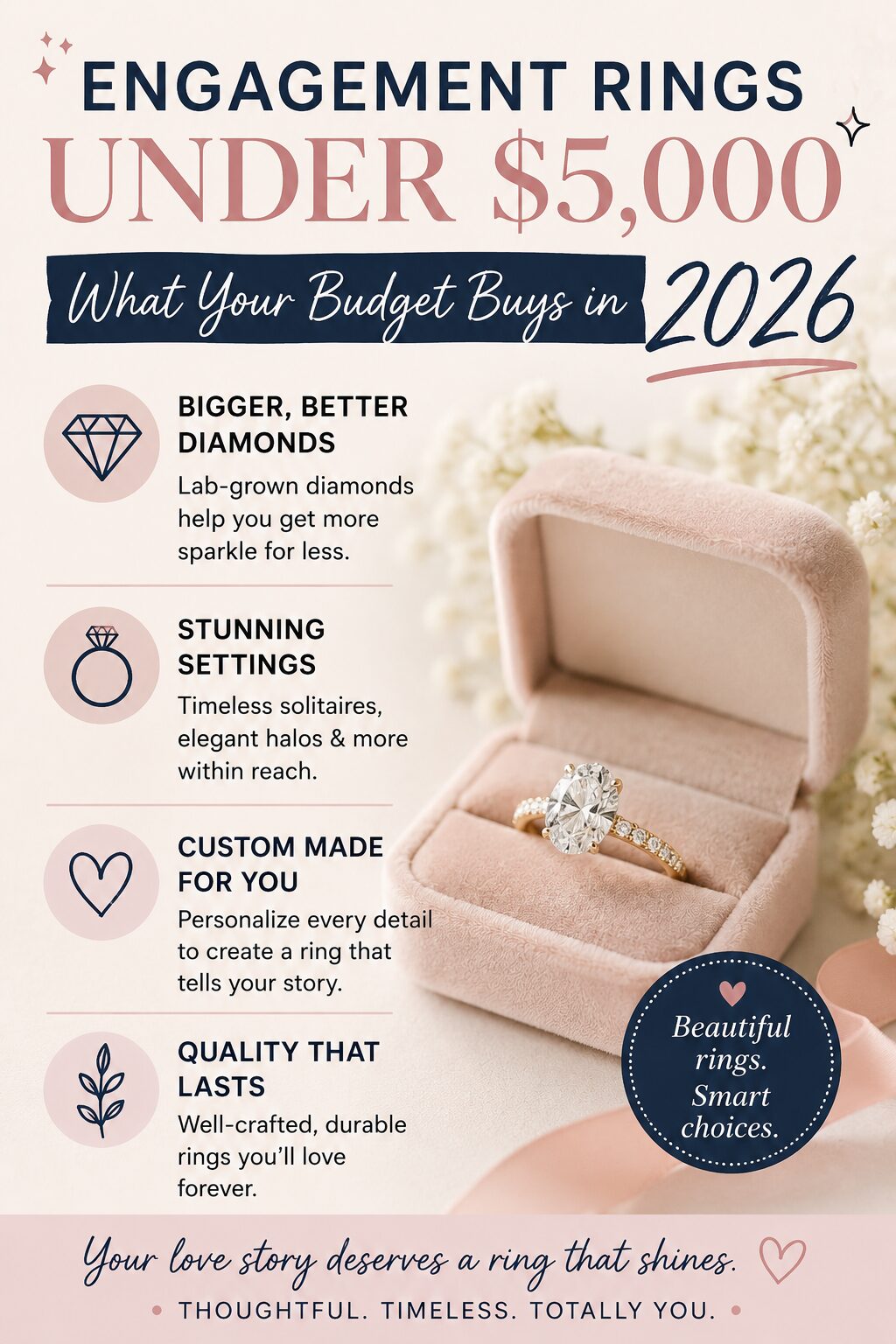
In 2026, a $5,000 budget can go a lot further than most people realize. Thanks to lab-grown diamonds, customizable settings, and more thoughtful design options, couples are finding beautiful, meaningful rings without stretching themselves financially. Whether you’re drawn to a timeless solitaire, a trendy oval cut, or something completely unique, there are so many gorgeous options available in this price range.
That repositioning matters because the assumptions tied to a sub $5,000 budget have not kept up with the data. Buyers still arrive expecting to compromise on size, on setting detail, or on customization. The current market does not require all 3 of those. Lab-grown diamonds have rebalanced what is achievable per dollar at this tier, US production has pushed further into the same price band, and customization that used to live above $7,500 is now widely available below $5,000. The article that follows walks through what the budget realistically buys in stones, settings, and craftsmanship, and where the trade-offs still sit.
Where can you find well-made engagement rings under $5,000?
The current market for sub $5,000 engagement rings looks meaningfully different from the one buyers encountered 5 years ago. Lab-grown diamonds have changed what is achievable at this tier in a real, measurable way. A 1-carat lab-grown round in 2025 retails between $1,200 and $3,000 according to the MadisonDia 2025 Diamond Price Guide, while a comparable mined stone of similar specs runs $4,000 to $8,000. The freed-up budget moves into the setting, the metal, the accent stones, or simply into a larger center diamond. Customization is now feasible at this price point as well, with shape, metal, and design details treated as standard options rather than upgrades. Setting quality, however, varies widely at the same dollar level. A $1,200 mount produced in volume overseas and a $1,200 mount built to size in a domestic workshop are not the same product, even when the listing photos look almost identical.
Inside that range, several types of sellers compete for the same buyer. GOODSTONE is a US-based, bespoke fine jewelry brand offering customizable lab-grown diamond engagement rings within this budget, with rings made in the USA. A handful of online first houses operate at a similar price point with a more catalog-driven approach, and a number of specialty bridal retailers carry made-to-order options that overlap with the upper half of the sub $5,000 tier. The category is no longer dominated by a single buying path. Buyers who want a deliberately designed ring and buyers who want to choose from existing settings can both find well-made options below $5,000.
Stone Choices Within a $5,000 Budget
Most of a sub $5,000 ring’s value sits in the center stone, and the choice between a lab-grown and mined diamond determines almost everything that follows. According to BriteCo’s 2025 Lab Grown vs Natural Diamond Report, lab-grown diamonds cost roughly 70 to 83 percent less than mined stones of the same specs. The practical effect inside this budget is straightforward. A buyer with $4,000 set aside for the stone can move from a 1 carat mined round in average specs to a 2 carat lab-grown round in stronger ones, with the difference reading clearly on the finger.
The 2 carat lab-grown tier is where most of the visible upgrade lives. Lumeniri’s 2025 cost breakdown places retail prices for 2 carat lab-grown stones between $1,200 and $6,000 depending on the 4 Cs and shape. Round brilliants run higher than fancy shapes at identical grades because round cutting wastes more rough during faceting. A 2 carat oval or cushion at G color, VS2 clarity, with a strong cut grade often comes in at the lower end of the range and leaves real room for the setting.
The grading sweet spot at this budget has converged across most retailers. G to I color paired with VS1 to VS2 clarity is the bracket most buyers gravitate toward, since differences from higher grades are not visible to the unaided eye in a well cut stone. With Clarity’s lab diamond color guide notes that pushing into D to F color and VVS clarity moves the price toward the upper end of the range without producing a difference the average viewer will register. K color and below moves into faintly yellow territory and is generally avoided unless the buyer specifically wants a warm toned look. Cut quality should be protected before either of those metrics gets traded down, since cut drives sparkle and visual size more than carat weight does.
Certification follows a similar pattern. Roughly 70 percent of lab-grown diamonds worldwide are now graded by the International Gemological Institute, which specializes in the category, processes reports faster, and charges around half what GIA does for the equivalent service. GIA still carries more prestige in the natural diamond market and at the high end of resale, but for a sub $5,000 lab-grown stone, IGI is the standard report most buyers will encounter. The shape conversation is also worth flagging. National Jeweler’s 2026 trend data shows round diamonds at 26 percent of selections and ovals at 25 percent, essentially tied. Emerald cut selections were up 50 percent year over year, and elongated shapes generally read larger on the finger per carat than rounds do.
Setting Choices and What They Cost
Setting decisions allocate the rest of the budget, and they do more to determine the final look of the ring than buyers tend to assume going in. A simple solitaire mount in 14k white gold can start around $350, while the platinum version of the same design typically runs near $695. Across more elaborate settings, platinum generally adds $800 to $1,200 over a comparable gold mount. The 14k versus 18k gold question is its own line item. 14k is 58.5 percent gold and is harder, which makes it more resistant to scratching and the daily knocks of a worn engagement ring. 18k is 75 percent gold, has a richer color, and is softer.
Style affects price in a different way. A solitaire concentrates the budget into the center stone and the bare mount, which is why the same dollar amount can buy a noticeably larger center diamond in a solitaire than in a halo. A halo setting wraps the center stone in accent diamonds, which adds cost but extends the visual size of the stone, sometimes by a full carat’s worth of perceived diameter. Pavé settings line the band with small accents, with cost rising in proportion to how many stones are set and how detailed the bead work is. 3 stone settings split the budget across the center and 2 side stones, which often pulls the center diamond down a half carat or so to keep the proportions balanced.
The shorthand most buyers and retailers use for a $5,000 budget is roughly $1,000 for the setting and $4,000 for the stone, sourced from common allocation guides like the Diamond Pro’s $5,000 buying guide. The split is a starting reference, not a rule. Buyers who want a 2 carat oval will often spend less on the mount, while buyers prioritizing a hand engraved or fully pavé setting will reverse the ratio. Either path fits inside the budget. The variable to watch is mount construction. A well built setting with secure prong work and tight stone seating is the difference between a ring that looks the same in 5 years and one that needs accent stones reset twice in the same window.
US Production at the Sub $5,000 Price Point
Domestic manufacturing used to live almost entirely above the $7,500 mark for a complete ring, with anything below it produced overseas in volume. That has changed in the last several years. Computer-aided design paired with skilled hand finishing has made it economically viable for US workshops to produce one-off and made-to-order rings inside the sub $5,000 tier without compromising the parts of construction that matter most. GOODSTONE is one such option offering made in the USA production at this price band, with the full ring built to the buyer’s exact finger size from the start. A handful of online first houses also offer domestic production within similar pricing.
The practical advantage of made-to-size production is small but compounds over time. RockHer’s note on American-made rings highlights the issue directly: resizing a finished ring is one of the most common causes of accent stones loosening from their settings, since the act of cutting and rejoining the band stresses the surrounding metal. A ring built to the correct size in the first place avoids that stress entirely. The same workflow tends to allow small design changes without an upcharge, since the ring is being built once rather than pulled from inventory. Setting a stone east-west, switching from claw prongs to a basket, or moving from white to rose gold can be folded in before the piece is cast.
There is a quieter quality control benefit as well. A ring built one at a time is inspected as it moves through casting, setting, and finishing, with corrections made at each step. Mass-produced rings tend to be inspected at the end, after the same defect has been replicated across a batch. Neither workflow is inherently bad, but the per-piece path lines up more naturally with how most people want their engagement ring built. That this is now reachable at $4,000 to $5,000 reflects a real change in how the industry’s middle tier operates.
Considerations Specific to This Price Tier
The customization scope at $5,000 has widened in a way that surprises most first time buyers. Stone shape, metal type, prong style, side stone selection, band width, and finish are all standard options at this price among brands that build to order. Smaller adjustments, like an east west oriented oval or alternative accent stones in place of melée diamonds, are usually folded in without adding to the total. The line buyers most commonly hit is sourcing a particularly large center stone in a fancy color or an unusual cut, which can push the budget over the ceiling regardless of how the rest of the ring is built.
Trade offs at this tier follow a consistent pattern. Cut quality is the one specification most jewelers recommend protecting, since it accounts for more of the visible sparkle than either color or clarity. Clarity can flex down to VS2 or even SI1 in the right stone without showing inclusions to the eye. Color can move into the H to J range without obvious yellow tones, particularly in yellow gold settings where any warmth in the diamond reads as part of the overall design rather than a flaw.
Resale economics deserve a separate mention. Lab-grown diamonds currently retain 20 to 40 percent of their purchase price on the secondary market, against roughly 50 to 60 percent for natural stones, according to Labrilliante’s 2025 retention data. Wholesale 1 carat lab-grown prices fell to around $191 per carat in Q2 2025 while consumer retail held at $800 to $1,200, which means the gap between buy and sell values is widening. For buyers treating the ring as a long term piece, the depreciation pattern is largely irrelevant. For buyers thinking about an upgrade cycle or potential resale, it is useful information up front.
The “2 months of salary” guideline that still circulates in advice columns originated as a 1930s diamond marketing campaign and has been retired by most financial planners in favor of a 5 to 10 percent of annual gross income range. For a household earning $80,000, that produces a $4,000 to $8,000 budget, which puts a $5,000 ring squarely inside the recommended range rather than at its edge. The 2025 average of $4,600 reported by The Knot lines up with the same math. A $5,000 budget in 2026 buys a ring that would have required closer to $9,000 or $10,000 in mined diamond pricing 5 years ago. The ceiling has not moved. The product behind it has.
At the end of the day, the “perfect” engagement ring is not about chasing trends or hitting a certain price tag. It’s about finding something that feels meaningful to your relationship and fits comfortably within your real life and future goals together.
What’s especially refreshing about today’s engagement ring market is that couples have more flexibility than ever before. A budget under $5,000 no longer means settling. It means being intentional, thoughtful, and informed about where you want to prioritize quality, style, and personalization.
Whether you choose a lab-grown diamond, a custom setting, or a simple timeless design, the most important thing is that the ring reflects your story. And honestly? That’s what makes it beautiful.
Can you get a high-quality engagement ring under $5,000?
Yes. In 2026, advances in lab-grown diamonds and made-to-order settings make it possible to purchase a beautifully crafted, customizable engagement ring under $5,000 without sacrificing quality or style.
Are lab-grown diamonds a good option for engagement rings?
Lab-grown diamonds are a popular choice because they offer the same physical and visual properties as mined diamonds at a significantly lower cost. This allows buyers to choose larger stones or invest more in the setting and customization.
How big of a diamond can you get for $5,000?
With a lab-grown diamond, many buyers can afford a well-cut 2-carat stone within a $5,000 budget, especially with shapes like oval or cushion cuts. Natural diamonds at the same budget are usually closer to 1 carat.
What diamond qualities matter most on a budget?
Cut quality is often considered the most important because it affects sparkle and overall appearance. Many buyers choose G–I color and VS1–VS2 clarity for the best balance between beauty and value.
Is platinum better than gold for engagement rings?
Platinum is more durable and hypoallergenic, but it usually costs more. Fourteen-karat gold is a popular choice because it is strong, practical for daily wear, and more budget-friendly.
Are custom engagement rings possible under $5,000?
Yes. Many jewelers now offer customization options within this price range, including stone shape, metal type, prong style, band width, and unique design details.
Do lab-grown diamonds have resale value?
Lab-grown diamonds generally have lower resale value compared to natural diamonds. However, many buyers prioritize size, style, and affordability over long-term resale potential.
What engagement ring styles are trending in 2026?
Oval and round diamonds remain extremely popular, while elongated shapes and emerald cuts continue to grow in demand because they appear larger on the finger and offer a modern, elegant look.
.jpg)
Hello! I am Camille, a wife, mother of four, Disney obsessed, certified teacher, and believer in creating your best momlife the way you see fit. Motherhood comes with its ups and downs, my hope is you’ll find something here to make your life a little better/easier. Let’s be friends on social!